



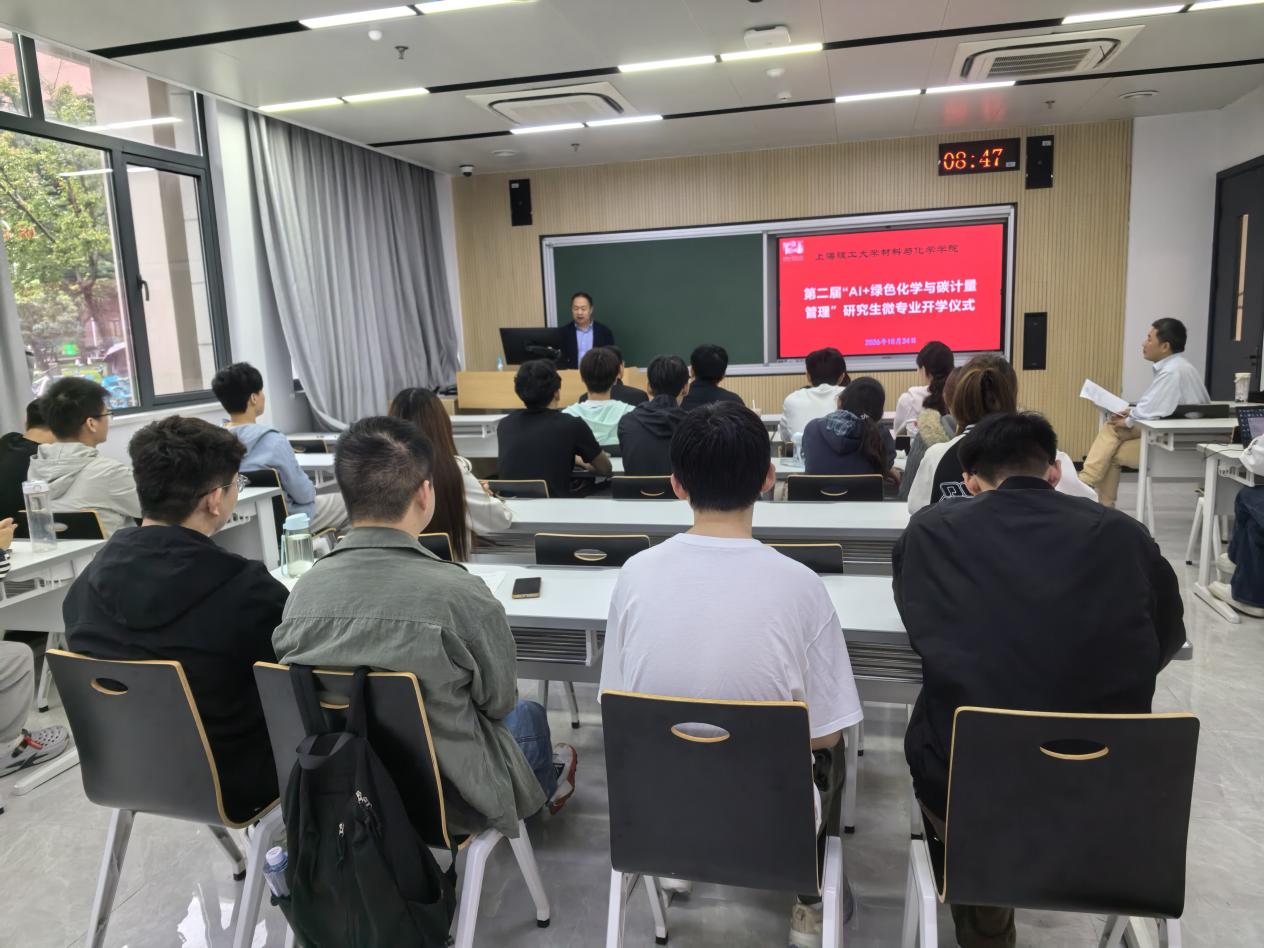
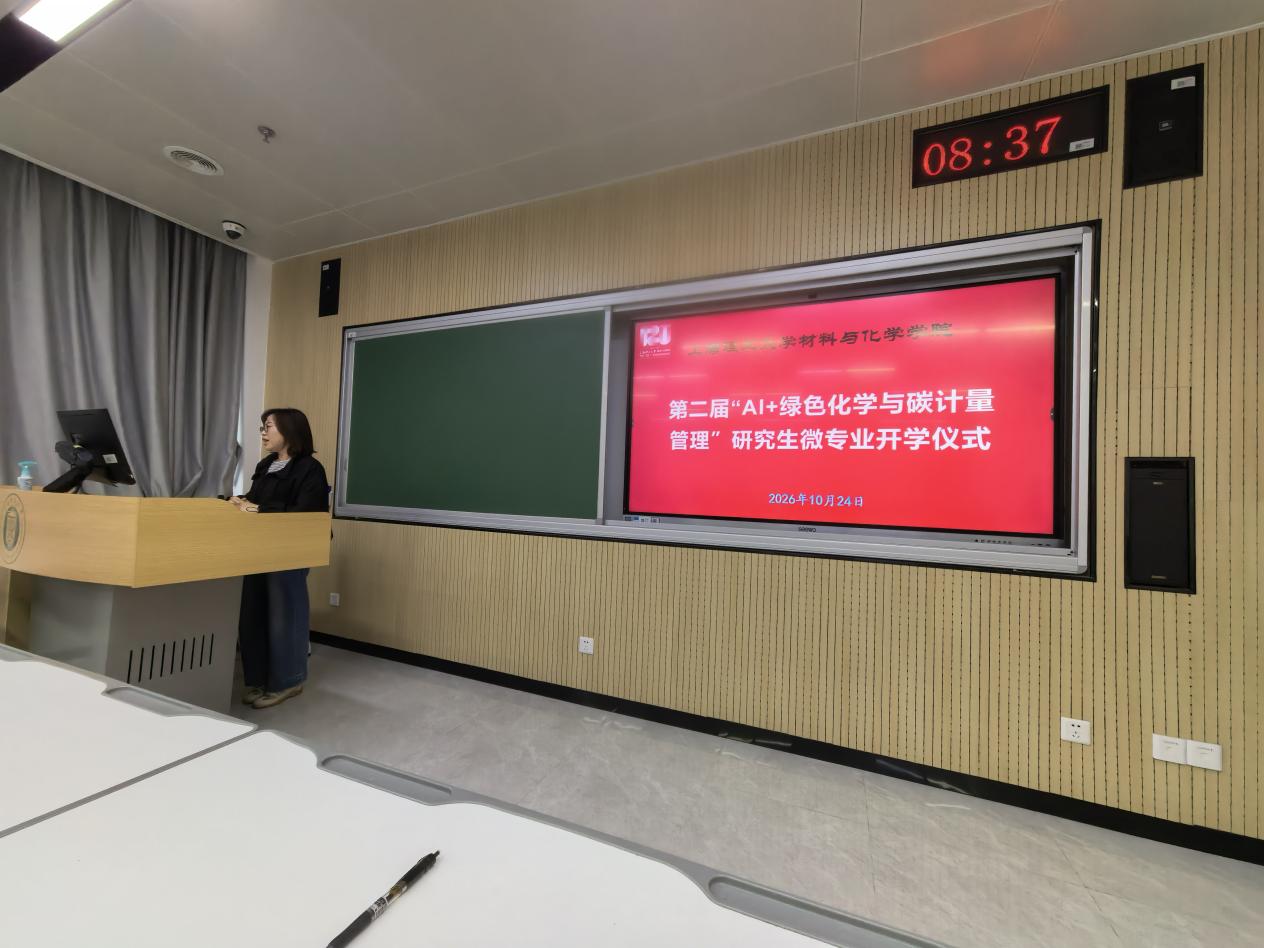
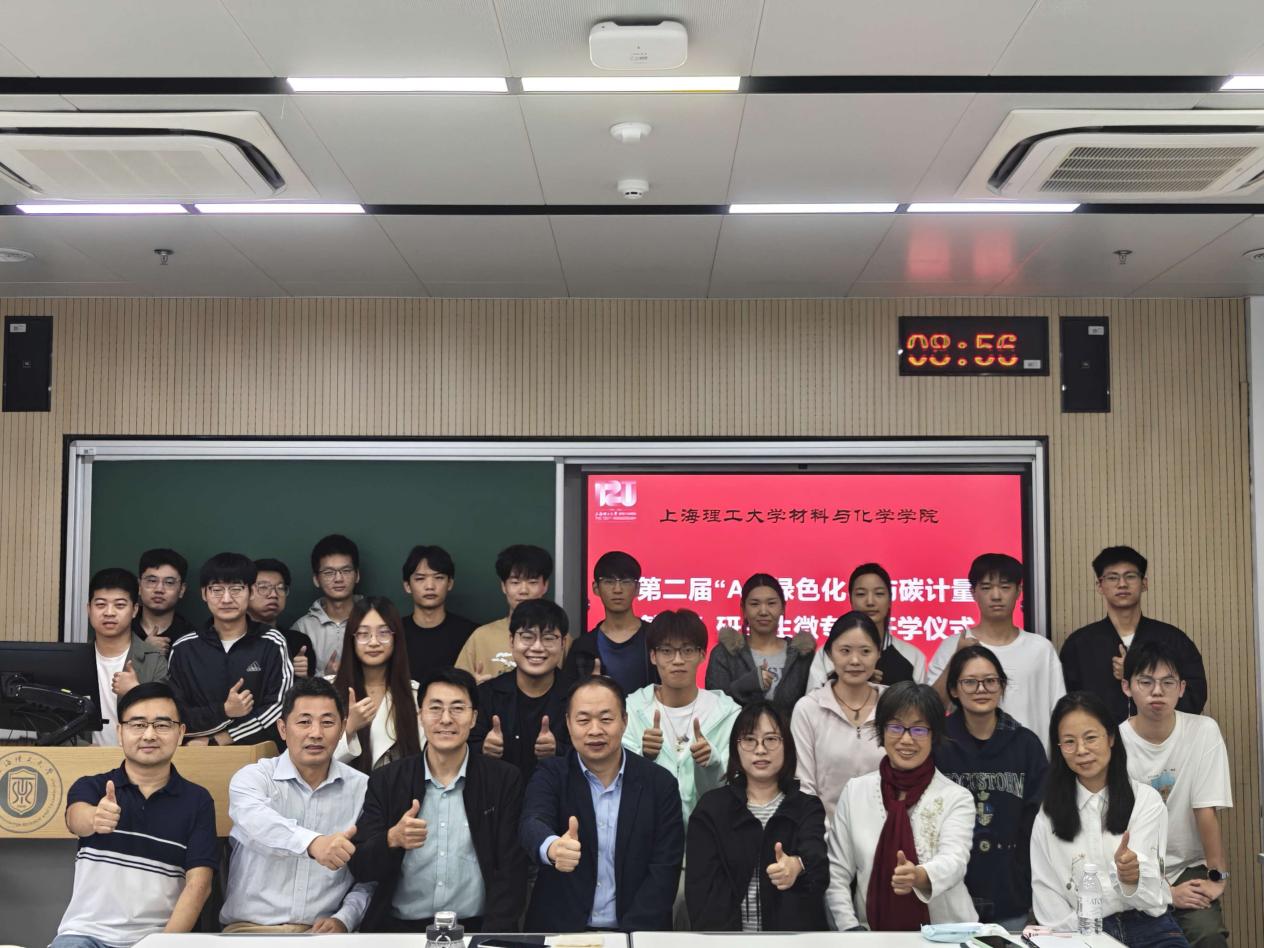
On the morning of October 24, 2026, the opening ceremony for the second cohort of the graduate micro-program “AI + Green Chemistry and Carbon Accounting Management” was held in Room 104, Teaching Building No. 4, 334 Jungong Road Campus. Leaders from the School of Materials and Chemistry, enterprise representatives, course instructors, students of the current cohort and alumni representatives of previous cohorts attended the ceremony. The ceremony was presided over by Dr. Ma Jie, faculty member of the micro-program.
The graduate micro-program “AI + Green Chemistry and Carbon Accounting Management” was selected for the Ministry of Education’s “Double-Thousand Plan” this year, and its certificate is verifiable on the China Higher Education Student Information Network (CHSI). Professor Zhang Shuping, Program Director, stated: “It is hoped that this micro-program will serve as a spotlight that bridges academic disciplines and industries, a ladder leading from classrooms to workshops, and a rehearsal for transitioning from campus to the workplace.” She aims to build this micro-program into a high-quality program that meets educational demands and satisfies both teachers and students.
At the opening ceremony, alumni representatives from the first cohort shared their learning experiences and noted that training within the micro-program had helped them improve their professional competencies. Senior Engineer Wang Ying, an industry expert, introduced practical training tracks. She remarked, “This micro-program is not just a concept, but a tangible skill set,” and encouraged students to study diligently and practice earnestly to support the national “Dual Carbon” strategy. Subsequent trainees will be able to carry out on-site practical training at partner enterprises, which will provide access to real industrial projects. Li Wei, Vice Dean of the School of Materials and Chemistry, extended a welcome to the new cohort. Referencing the university’s 120th anniversary and postgraduate education reform initiatives, he pointed out that the micro-program acts as an important extended platform for the school’s postgraduate training. It effectively complements classroom instruction, strengthens students’ engineering practical capabilities, and serves as an excellent model for integrating industry and education and nurturing talent.
Following the opening ceremony, industry expert Wang Ying delivered the first lecture. Her presentation covered intelligent monitoring of VOCs in industrial parks, pollution source tracing, data fusion and risk early warning. Drawing on engineering cases including three-dimensional monitoring networks, diffusion source-tracing models and analytical quality control frameworks, she elaborated on the implementation pathways and application value of digital and intelligent technologies in ecological and environmental governance, helping students form a complete logical framework from monitoring data to pollution assessment. In the afternoon, Professor Cheng Ping taught the course Artificial Intelligence and Chemistry, focusing on the selection of AI tools for scientific research and AI-assisted writing of research papers and reviews.
Full text: https://chxy.usst.edu.cn/2026/1029/c3680a373283/page.htm