



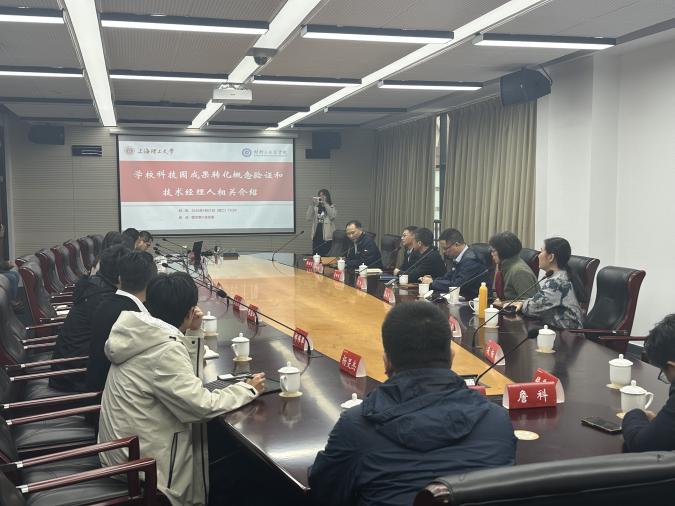
To further enhance the awareness and capability of faculty members in the School of Materials and Chemistry regarding the transformation of scientific and technological achievements, to bridge the key link from laboratory research to industrialization, and to fully leverage the platform resources of the university's National University Science Park to promote deep industry-university-research integration, the School of Materials and Chemistry held a special training and exchange meeting on the transformation of scientific and technological achievements on the afternoon of April 21, 2026, in the Second Conference Room of the Library and Graphic Information Building. The meeting specially invited a delegation from the University of Shanghai for Science and Technology National University Science Park, including General Manager Li Shuangquan, Deputy General Manager Chen Yang, Manager of the Science and Technology Innovation Service Department Chen Yunpeng, and Event Specialist Qu Lujing, to provide targeted guidance and training. The meeting was chaired by Professor Miao Yuqing, Associate Dean of the School, and faculty representatives from various departments attended the meeting.
At the beginning of the meeting, Associate Dean Miao Yuqing, on behalf of the school, extended a warm welcome and sincere gratitude to the science park team. He pointed out that the transformation of scientific and technological achievements is a core function of universities in serving social and economic development, and is also a key lever for the school to promote disciplinary construction, talent cultivation, and alignment with industrial needs. This special training aimed to help all faculty members systematically understand the entire process of achievement transformation, accurately grasp the policies and pathways of core steps such as concept validation and technology manager services, break down information barriers between research and industry, guide faculty to better align research outcomes with market demands, and transform more laboratory achievements into actual productive forces.
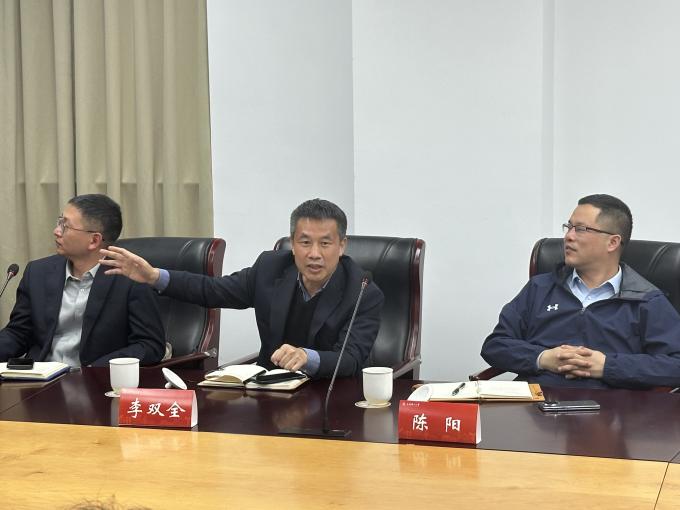
During the training session, General Manager Li Shuangquan provided a comprehensive introduction to the development overview, strategic positioning, and operational system of the University of Shanghai for Science and Technology National University Science Park. He detailed the development history of the science park since its establishment in 2005, explained the core model of collaborative development known as one university, one district, one park, and the overall operational framework of one main line, six teams, and nine platforms. He stated that as a national university science park and a national technology transfer demonstration institution, the science park has always positioned itself as an innovation engine for advanced manufacturing, focusing on the university's advantageous disciplines such as intelligent manufacturing and life health. It has built a full-chain service system covering basic research, applied development, achievement transformation, enterprise incubation, and industrial agglomeration. To date, it has facilitated the transformation of scientific and technological achievements totaling 1.2 billion yuan, assisted incubated enterprises in securing external financing of 240 million yuan, and has become the first stop for the university's faculty and students in achievement transformation and entrepreneurship and innovation. He also highlighted the science park's policy breakthroughs and practical achievements in areas such as full-authority reform in achievement transformation, university-enterprise collaborative research, and the construction of pilot-scale maturation platforms, giving attending faculty a comprehensive understanding of the science park's platform resources and service capabilities.
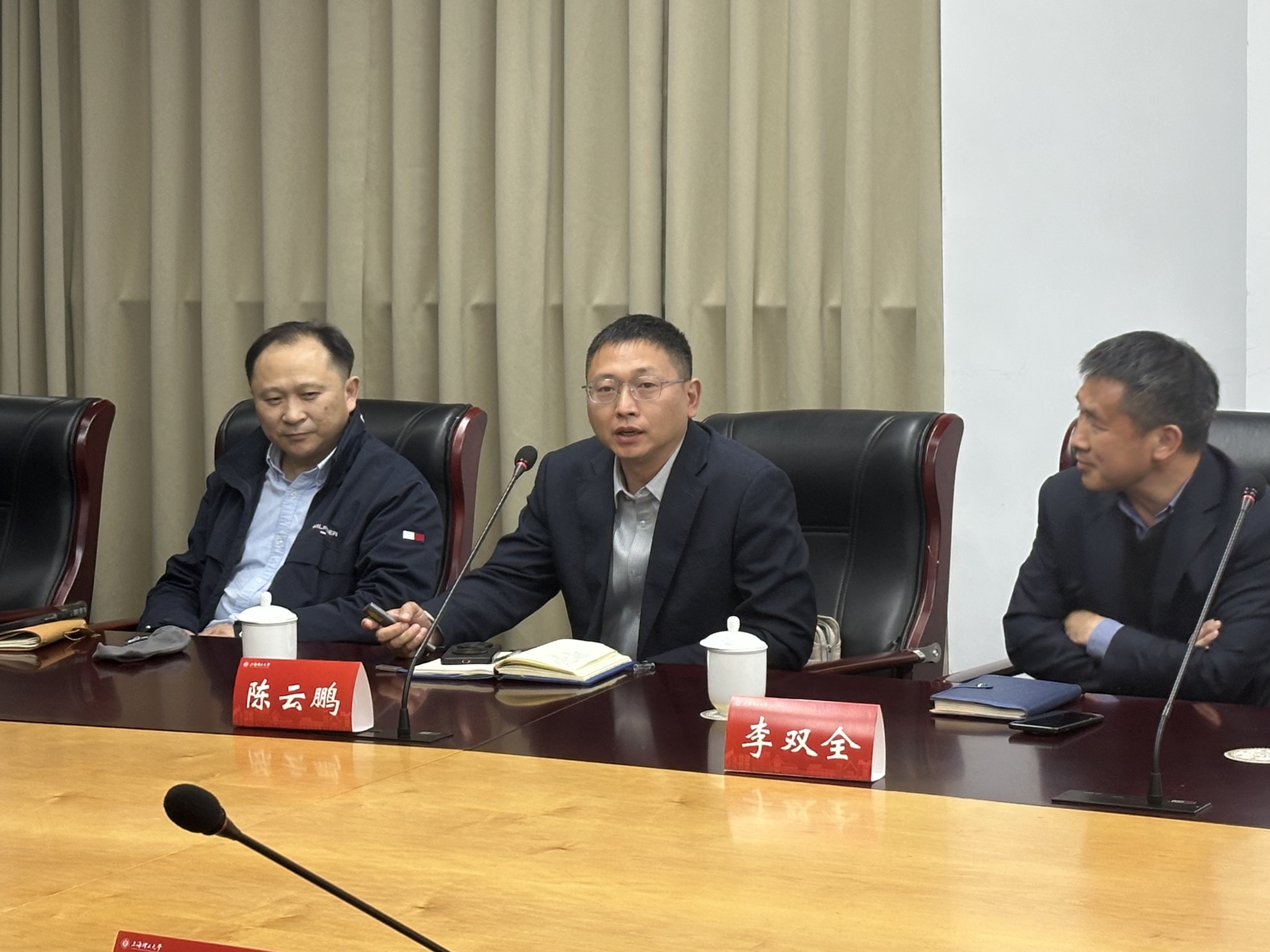
Subsequently, Manager Chen Yunpeng delivered a special report on achievement transformation work under the theme Implementing Concept Validation to Empower Achievement Transformation. He systematically explained the core connotations and policy background of concept validation, focusing on the science park's four-stage, full-process closed-loop concept validation system of project initiation – development – commercial validation – acceptance. He clarified the system's core positioning of focusing on technological achievements with Technology Readiness Levels (TRL) 3-6 and conducting dual-dimensional validation of technical feasibility and commercial value. He detailed the science park's three-database linkage mechanism (project database, demand database, expert database), the results shelf management model, and the four core pathways for achievement transformation: technology licensing, technology transfer, technology services, and cooperative development. He also provided detailed explanations of the application standards, review processes, funding support, and space support policies for concept validation projects. Furthermore, focusing on the development of technology manager teams, he introduced the science park's full-process management mechanism of recruitment – filing – training – assessment – incentives – exit and the core service content of technology managers in project selection, resource matching, and entrepreneurship acceleration, allowing attending faculty to clearly grasp the practical pathways and supporting resources for achievement transformation.
During the interactive exchange session, attending faculty actively asked questions based on their own research work, focusing on core issues such as criteria for determining technology readiness levels, key application points for concept validation projects, channels for aligning university-industry needs, support policies for start-up incubation, and models for collaborative horizontal projects. The science park team provided detailed and professional answers to each question, using specific transformation cases to break down the difficulties and solutions at various stages of achievement transformation. The atmosphere was lively, and faculty expressed that they had gained a great deal from the session.
This special training and exchange meeting provided a professional platform for faculty to learn about achievement transformation policies, connect with resources, and exchange experiences. It effectively broke down information barriers between university research and industrial transformation, further stimulating faculty's enthusiasm for industry-university-research cooperation and achievement transformation. Moving forward, the School of Materials and Chemistry will continue to deepen regular cooperation with the University of Shanghai for Science and Technology National University Science Park, establish a long-term mechanism for school-park collaborative achievement transformation, continuously improve the full-process service system for achievement transformation, guide faculty to leverage disciplinary strengths to meet industrial needs, promote the transformation of more high-quality research outcomes, and inject new momentum into the university's construction of a high-level institution and the high-quality development of the regional industry.
Full text: https://chxy.usst.edu.cn/2026/0422/c3680a360359/page.htm