




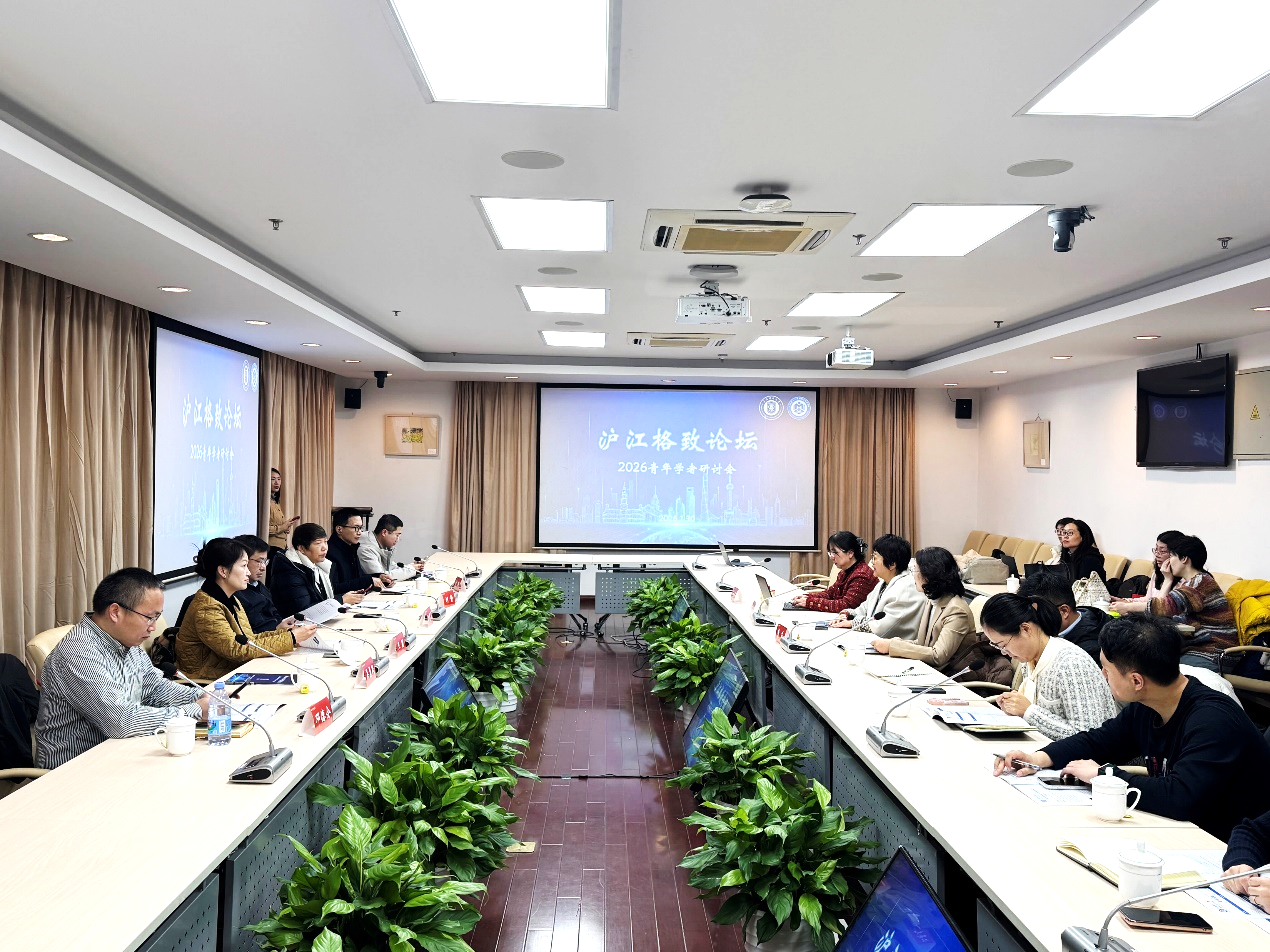
To deepen academic exchanges in the fields of materials and chemistry, align with academic frontiers and national strategic demands, promote the interdisciplinary integration of AI with materials chemistry, and boost the research capabilities of young teachers as well as the construction of an organized scientific research system, the School of Materials and Chemistry of the University of Shanghai for Science and Technology successfully hosted the 2026 Hujiang GeZhi Forum – Young Scholars Symposium on January 30. Renowned experts and young scholars from universities and research institutes across the country gathered at GeZhi Hall to discuss scientific research innovation and disciplinary development through academic reports, free discussions and other forms.
This symposium was hosted by the School of Materials and Chemistry of the University of Shanghai for Science and Technology and organized by the Young Teachers Association of the school. Focusing on key research directions such as biomedical materials, electrochemical energy storage, catalytic conversion and flexible electronics, the conference featured a number of high-quality academic reports, building a high-level communication platform for presenting research achievements, colliding innovative ideas and expanding cooperation networks. It provided strong support for the growth and development of young scholars and the collaborative research of scientific research teams.
At the symposium, ten young scholars took the stage one after another to share their latest research findings. Dr. Zhu Lijuan, a tenure-track researcher at the University of Shanghai for Science and Technology, proposed a carrier-free precise targeted delivery strategy, offering new ideas for the combined nucleic acid drug therapy of malignant tumors; Dr. Chen Tianju focused on intelligent plasticity and digital twin manufacturing, elaborating on the development path of constitutive models based on deep learning; Professor Yuan Tao centered on the design of advanced materials and devices for sodium-ion batteries, sharing the analysis of structure-activity relationships of electrode materials and experience in industry-university-research transformation; Associate Professor Hao Weiju addressed the core challenges of hydrogen production from seawater electrolysis, introducing the directional regulation technology and chlorine corrosion resistance mechanism of boron-based composite electrodes. In addition, Scholars Song Wenliang, Yue Bingbing, Wang Shige, Bi Wei, Zhang Wei, Yang Weiwei and others conducted in-depth discussions on topics such as light-responsive porous materials, polymer semiconductors for electronic skin, nanotheranostic platforms, photocatalytic CO₂ reduction, polymer carbon resource conversion, and water electrolysis catalyst modification respectively. The report content, which combined academic depth with application value, aroused extensive resonance among the participants.
Full text: https://chxy.usst.edu.cn/2026/0204/c3680a356245/page.psp